PERRY, SCHUMAN, AND HARRIS
Notes on the composers and the pieces
Julia Perry
Short Piece for Large Orchestra
William Schuman
A Free Song
Roy Harris
Symphony No. 6 “Gettysburg”
Return to Home Page |
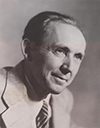
Roy Harris: Symphony No. 6 “Gettysburg”
An American original, Roy Harris (1898–1979) was born into a modest family of mixed ancestry in Oklahoma. The family lived in a log cabin on a farm until 1903 when his father sold their farm and moved them to the San Gabriel Valley in California. Harris’s early music training included piano studies with his mother and playing the clarinet in high school. After serving in the Army during World War I, he attended the University of California at Berkeley, where his mentor, the composer Arthur Farwell, introduced him to Walt Whitman’s poetry and helped him develop a distinctive musical style. Thanks to Guggenheim fellowships, Harris was able to move to Paris, where he studied with Nadia Boulanger, studied Renaissance music, and wrote his first noteworthy pieces.
Many of Harris’s early works reflect his idealistic view of America and freedom, but in time he became conscious of the country’s social problems and injustices, which surface in his later works. Much of his music draws sonic pictures of America’s landscape and its history with works relating to Abraham Lincoln, Pere Marquette, John Kennedy, Gettysburg, San Francisco, Philadelphia, and Kentucky. He synthesized his musical style of Gregorian chant, Renaissance polyphony, Baroque forms, Celtic and American folk music, New England hymns, gospel, jazz, Bach, and Beethoven.
In Roy Harris: A Bio-Bibliography, Dan Stehman notes that Harris based his harmony on the overtone series, favoring open fourths and fifths and major and minor triads that he superimposed upon each other to create “polychords.” His chord progressions often start simply and grow new triads by linking one chord to the next. He often created bright or dark chords by choosing a fitting note for the bass. He preferred modes to major and minor scales, often combining two to produce polytonality. His melodies range from short motifs to long lines evolved from those short motifs. While Harris employed frequent meter changes in his early works, he achieved greater freedom in later works by allowing rhythms to flow over bar lines and employing odd accents. His orchestration often pits one section against another. He liked big horn gestures, “open air” sounds from high string polychords, and trumpet melodies breaking through the orchestra. Much of his music is structured, yet free, open, and flowing, as if it is being created as we hear it.
Harris took a serious interest in Abraham Lincoln partly because he saw aspects in Lincoln’s life that touched his own. One Lincoln inspired work was Symphony No. 6 “Gettysburg”, a broad, spacious, sonorous piece whose movement titles are related to Lincoln’s Gettysburg Address.
The ‘Awakening’ movement is inspired by the opening words of the President’s speech: “Fourscore and seven years ago our fathers brought forth on this continent, a new nation, conceived in liberty, and dedicated to the proposition that all men are created equal.” The music is vintage Harris with wide open spaces similar to those of his Third Symphony. After its solemn opening bars, enigmatic and melodic gestures appear. After a symphonic struggle, a triumphant line appears and leads to a towering melody that emerges from the chaos.
‘Conflict’ reflects the following words: “Now we are engaged in a great civil war testing whether that nation—or any nation, so conceived and so dedicated—can long endure.” It begins with a sad slow march of defeat that builds in intensity then turns frenetic until scattered brass attacks bring it to a halt.
‘Dedication’ combines intimacy and tragedy within rich string textures. It is surprisingly calm, austere, and emotional. The low strings produce a line that rises through the orchestra and expands until a new melody emerges leading to a lament and then a peaceful conclusion. “We are met on a great battlefield of that war. We have come to dedicate a portion of that field, as a final resting place for those who here gave their lives that that nation might live. It is altogether fitting and proper that we should do this. But, in a larger sense, we cannot dedicate, we cannot consecrate, we cannot hallow this ground. The brave men, living and dead, who struggled here, have consecrated it far above our poor power to add or detract. The world will little note nor long remember what we say here; but it can never forget what they did here.”
‘Affirmation’ is inspired by the last paragraph of the speech. “It is for us the living, rather, to be dedicated here to the unfinished work which they who fought here have thus far so nobly advanced. It is rather for us to be here dedicated to the great task remaining before us, that from these honored dead we take increased devotion to that cause for which they gave the last full measure of devotion that we here highly resolve that these dead shall not have died in vain; that this nation, under God, shall have a new birth of freedom, and that government of the people, by the people, for the people, shall not perish from the earth.” The movement begins with rich brass tone, then turns raucous and joyous toward the end. Much of it looks back to an earlier Harris orchestral work, American Creed (1940). It creates a fugue in three sections followed by a coda. Silent intervals, solo horn passages, repeated patterns, and woodwind fragments combine to create a colorful conclusion.
The symphony’s premiere was played by the Boston Symphony conducted by Serge Koussevitzky on April 14, 1944.
—Roger Hecht
Roger Hecht plays trombone in the Mercury Orchestra. He is a former member of Bay Colony Brass (where he was also the Operations/Personnel Manager), the Syracuse Symphony, Lake George Opera, New Bedford Symphony, and Cape Ann Symphony, as well as trombonist and orchestra manager of Lowell House Opera, Commonwealth Opera, and MetroWest Opera. He is a regular reviewer for American Record Guide, contributed to Classical Music: Listener’s Companion, and has written articles on music for the Elgar Society Journal and Positive Feedback magazine. His fiction collection, The Audition and Other Stories, includes a novella about a trombonist preparing for and taking a major orchestra audition (English Hill Press, 2013).
Read about Julia Perry
|
